
now loading...
Vietnam is a global heavyweight in agricultural exports. It is currently the world’s largest exporter of pepper, and the second-largest exporter of rice, running head-to-head with Thailand for the runner-up post, but trailing India. It is also the world's second-largest coffee producer and exporter, behind Brazil, and is, in fact, the top producer of Robusta coffee.
Despite this dominance, agricultural producers and agribusinesses in the country remain vulnerable to price fluctuations dictated by distant exchanges in London or New York City.
For this reason, the Vietnam International Financial Centre ( VIFC ) is seeking to have a more tangible impact on agriculture. By developing a sophisticated commodity derivatives market, Vietnam aims to have a greater say in global pricing of agricultural products.
This vision was a centerpiece of the UK-Vietnam Open Conference on the International Financial Centre 2026, held in Ho Chi Minh City on March 25, where around 100 delegates and experts gathered to help refine a roadmap for Vietnam’s economic sovereignty.
The two VIFC hubs, strategically located in Ho Chi Minh City and Danang, are designed to bridge this gap by providing a localized platform for price discovery that reflects regional supply and demand dynamics.
Risk management
Speaking at the event, Tran Huu Linh, head of the Agency for Domestic Market Surveillance and Development under the Ministry of Industry and Trade, noted that the VIFC would provide the essential “hard” infrastructure for modern risk management. Through commodity derivatives, which will be available via VIFC exchanges, agribusinesses can lock in favourable prices well before the harvest season even begins.
This mechanism allows farmers and exporters to effectively hedge against global market volatility, ensuring stability in a sector historically plagued by boom-and-bust cycles.
Explaining the mechanics of this system, Linh notes that a contract set at a specific price today for delivery in four months or so creates a chain of value. Beyond simple hedging, the derivatives market introduces a sophisticated investment layer where profits are captured through accurate price discovery.
As market expectations shift, these contracts can be traded multiple times, allowing stakeholders to capitalize on global trends while remaining physically in-country, he explains. This ensures that the financial gains from Vietnam’s primary products remain within its borders, rather than being captured solely by overseas brokerage firms.
The VIFC project’s global ambitions are underscored by the participation of international heavyweights such as Angela Knight, chair of the Astana Financial Services Authority, and Lord Justice Richard Snowden of the UK Court of Appeal.
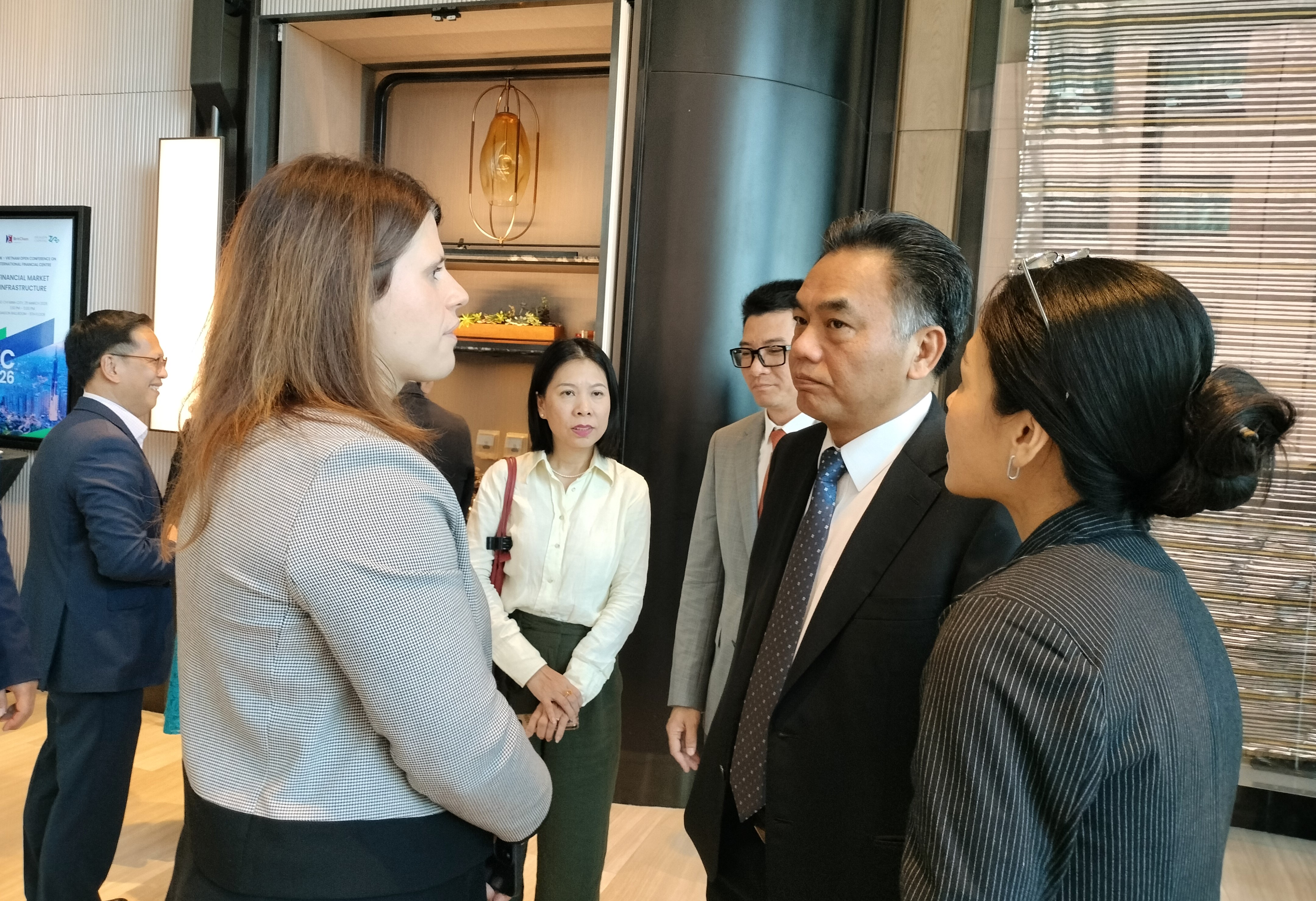 Ho Chi Minh City standing vice chairman Nguyen Loc Ha ( C ) and British consul general Alexandra Smith ( L ) discuss the strategic integration of international standards into the Vietnam International Financial Centre at the March 25, 2026 conference. ( Photo: Sao Da Jr )
Legal standards
Their involvement highlights a critical pillar of the VIFC roadmap: the adoption of international legal standards and common law principles. For global investors, a predictable legal environment is the primary prerequisite for entering an emerging market. By aligning its regulatory framework with British financial expertise, Vietnam is signalling its commitment to market integrity and investor protection.
Ho Chi Minh City standing vice chairman Nguyen Loc Ha says that following the VIFC’s official launch in late 2025, the megacity is prioritizing a transparent environment built on rigorous financial supervision.
“Ho Chi Minh City evaluates highly the core focus of this workshop, which centres on commodity derivatives and the legal frameworks necessary to foster a competitive environment,” the city leader says. Ha stresses that the collaboration with UK partners is vital in accelerating the city's progress towards becoming a regional financial powerhouse that serves the real economy.
British consul general Alexandra Smith in Ho Chi Minh City reaffirms the UK’s role as a “trusted partner” in turning this world-class vision into reality. She notes that the British Corporate Advisory Committee and various UK financial bodies are deeply engaged in sharing the technical blueprints required for such a complex undertaking.
Dominic Scriven, chairman of Ho Chi Minh City-headquartered Dragon Capital, says an efficient market infrastructure is the bedrock for building investor trust. By securing the long-term capital necessary to move Vietnam’s primary sectors up the global value chain, the VIFC is positioned to be the modern engine of Vietnam’s next phase of economic development.